
RGB LEDs are light-emitting diodes that combine three primary colors of light – red, green, and blue – to produce a wide range of colors. By adjusting the intensity of each color component, an RGB LED can create millions of different color combinations.
While conventional RGB LEDs are typically controlled by adjusting the electrical signals supplied to their individual color channels, addressable RGB LEDs take this concept a step further.
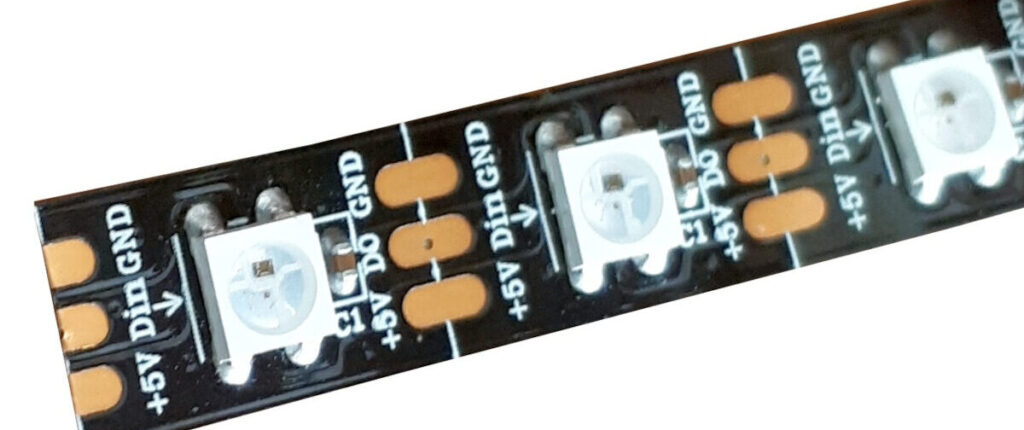
What Are Addressable RGB LEDs?
Addressable RGB LEDs, also known as smart pixels, combine red, green, and blue light-emitting elements with an integrated control circuit. This circuit receives digital commands from an external LED controller and adjusts the color and brightness of the LED accordingly.
They are called addressable because each LED in a strip, string, or matrix can be controlled individually.
This capability makes it possible to create complex lighting patterns, animations, and even video displays using thousands of individually controlled RGB pixels.
How Do Addressable RGB LEDs Work?
Unlike conventional LEDs, which are controlled by regulating the electrical current flowing through them, addressable RGB LEDs receive digitally encoded information that determines their color and brightness.
In many commonly used addressable RGB LEDs, each of the three color components is represented by 8 bits of data.
This results in:
- 8 bits for red
- 8 bits for green
- 8 bits for blue
Together, these 24 bits provide 2²⁴ possible color combinations—approximately 16.7 million colors.
The LED’s internal control circuit interprets the incoming digital data and adjusts the intensity of the red, green, and blue components accordingly.
Beyond 24-Bit Color
In recent years, addressable RGB LEDs offering higher color resolution have become increasingly available.
Some devices support 16 bits per color channel, resulting in a total of 48 bits per RGB pixel.
Compared with conventional 24-bit RGB LEDs, this provides significantly finer control over individual color intensities and smoother transitions between brightness levels.
However, the number of digitally representable color combinations should not be confused with the number of visually distinguishable colors or the actual color gamut of the LED.
Two Common Types of Addressable RGB LED Interfaces
Addressable RGB LEDs can be divided into two major groups based on their digital communication interfaces.
Three-Wire Addressable RGB LEDs
These LEDs typically use three electrical connections:
- V – Power supply
- GND – Ground
- D – Digital data input
The digital data signal carries the information required to control the individual LEDs.
Common examples include WS2811-based LED pixels, WS2812B, and SK6812 devices.
These LEDs use timing-sensitive communication protocols in which data is transmitted without a separate clock signal.
For detailed electrical characteristics and timing requirements, refer to the WS2812B datasheet.
Four-Wire Addressable RGB LEDs
The second group uses four electrical connections:
- V – Power supply
- GND – Ground
- D – Digital data input
- CLK – Clock signal
The additional clock line provides timing information for data transmission.
Typical examples include APA102 and HD107 addressable RGB LEDs.
The presence of a separate clock signal can simplify communication timing and enable higher data transmission rates, depending on the particular LED device and controller implementation.
Why Do Addressable RGB LEDs Need a Controller?
The main advantage of addressable RGB LEDs is their ability to display different colors and brightness levels independently, even when thousands of LEDs are connected within the same system.
However, this flexibility requires an electronic controller capable of generating correctly formatted digital data for every individual pixel.
Conventional, non-addressable RGB LED strips generally use shared control signals for their red, green, and blue channels. As a result, all LEDs connected to the same control channels display the same color and brightness.
Such strips are commonly used for ambient and decorative lighting.
Addressable RGB LEDs, on the other hand, make it possible to create dynamic lighting effects, moving patterns, animations, and video-based displays.
The difference is simple: conventional RGB LED strips control groups of LEDs together, while addressable RGB LED systems allow individual pixels to be controlled independently.
For practical implementations of addressable LED control, explore the Pixblasters LED controller solutions.
In upcoming Pixblasters Journal articles, we will explore how addressable RGB LEDs communicate with their controllers, how different LED protocols work, and what it takes to control thousands of RGB pixels in real time.